Visiting relatives in Ethiopia is not a holiday with family attached; it is a social obligation with a holiday somewhere inside it. For diaspora travellers — and for the partners and children they bring — the hard parts are almost never logistical. They are the coffee you cannot refuse, the cousin you cannot place, the money conversation nobody warned you about, and the quiet expectation that you will behave like someone who belongs. Here is how that actually works.
Key facts
- Budget for gifts
- US$300–800 is a realistic first-visit figure
- Coffee invitations
- Expect 2–3 a day; refusing outright causes offence
- Money requests
- Assume they will come; decide your policy in advance
- Greeting elders
- Bow slightly, offer right hand, support with left
- Yellow card
- Ethiopian-origin ID — eases stays, complicates insurance
- Realistic stay
- 3 weeks minimum if visiting extended family
The first rule: you are not a tourist here
Whatever your passport says, you will be received as family returning, and the standard applied is a family standard. That is a warm thing and a demanding one. It means people will be genuinely delighted to see you — and also that turning down an invitation, leaving early, or staying in a hotel instead of a relative's house carries meaning you may not intend.
The single most useful adjustment: build a schedule with half the appointments you think you can manage. Visits run long. A "quick greeting" at an aunt's house is ninety minutes minimum, and leaving before coffee is served is close to an insult. Three visits a day is a full day.
Coffee is the unit of social currency
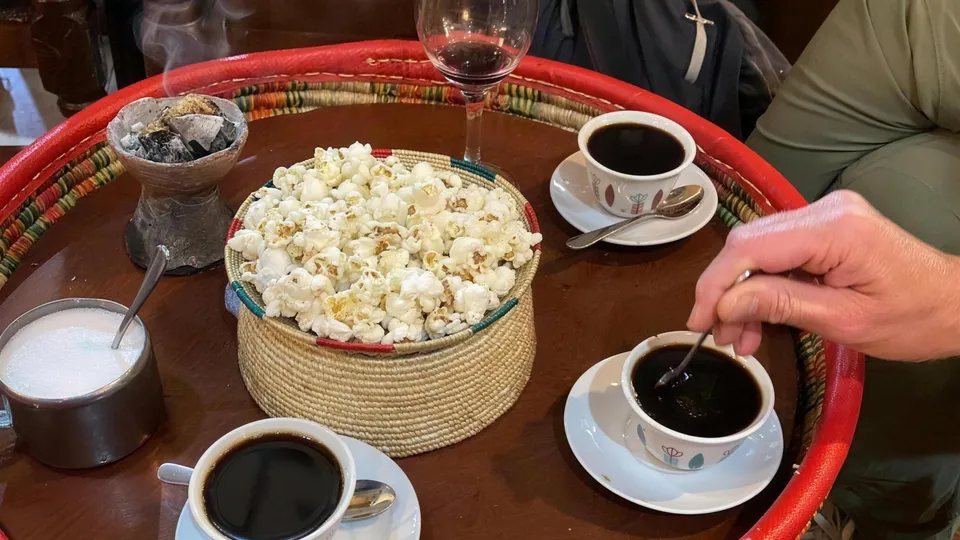
You will be offered coffee constantly — properly roasted, ground and brewed over perhaps forty minutes. Refusing outright reads as rejecting the household. If you genuinely cannot, the graceful exits are: accept the first cup (abol) and excuse yourself before the second and third; plead a doctor's orders; or accept and simply not finish it. Never decline at the door.
Understand what the ceremony costs the host — charcoal, time, and often a neighbour summoned to help. It is a gift of labour, and treating it as a beverage is where diaspora visitors most often, unknowingly, cause hurt. Our coffee ceremony guide covers the sequence itself.
Greetings, and the small physical grammar
- Elders first, always. Enter a room and greet the oldest person present before anyone else, including the person who brought you.
- The handshake is offered with the right hand while the left lightly supports your own right forearm — a gesture of deference. With close family, expect three alternating cheek kisses and a shoulder bump.
- Bow slightly to much older relatives. Some will offer a hand to be kissed or a shoulder to touch; follow their lead rather than initiating.
- Use the right hand for eating and passing. The left is for other purposes and the distinction is still felt.
- Gursha — being fed a rolled parcel of injera by hand — is affection, not theatre. Accept it, and offer one back to someone you are close to. Refusing is a genuine snub.

Gifts: many small, not few large
The instinct to bring one impressive present is the wrong one. You will meet dozens of people, and arriving empty-handed at the fourth household is worse than arriving modestly at all of them. What travels well and is genuinely valued:
- Perfume, quality soaps and skincare — small, light, high-status
- Children's clothes and shoes (bring sizes up; they grow before you return)
- Vitamins, painkillers, reading glasses — practical and expensive locally
- Coffee mugs, tea sets, kitchen gadgets for households
- Phone accessories, power banks, decent headphones for younger cousins
- Chocolate and sweets in bulk for the room full of children you did not expect
Avoid: heavy electronics that attract customs attention, anything requiring a warranty, and alcohol for observant Orthodox households, particularly during fasting seasons.
The money conversation
It is coming, so plan it. Requests are usually sincere and often urgent — a medical bill, school fees, a relative's business idea. The corrosive thing is not giving or refusing; it is inconsistency, which quietly creates a ranking among relatives that will outlast your trip.
A workable framework: decide a total before you fly; rank categories in advance (medical first, education second, emergencies third, business ventures last and rarely); give privately and equally within categories; and never promise future money to end an uncomfortable conversation. "I've set aside what I can this year, and it's committed" is a complete, respected sentence. A vague "we'll see" is heard as yes.
Bringing a non-Ethiopian partner or children
Your partner will be welcomed enthusiastically and interrogated affectionately — expect questions about religion, children and salary that would be intrusive elsewhere and are simply conversational here. Brief them beforehand so it lands as warmth rather than inquisition. A few learned Amharic greetings buy enormous goodwill; see our phrasebook.
Children born abroad tend to have a wonderful time and a difficult middle three days: the food is unfamiliar, the attention is relentless, and the altitude flattens them. Build in downtime, bring familiar snacks for the transition, and accept that your toddler will be carried off by relatives and returned sticky and happy. For the practical side of family travel, see family activities in Addis.
Practicalities diaspora visitors underestimate
- Three weeks minimum if you are visiting extended family in more than one town. Two weeks means disappointing someone.
- Stay with family for part of the trip, a hotel for the rest — and frame the hotel as convenience, not preference. Nobody objects to "it's near the airport for our early flight."
- Bring cash in crisp USD. Worn or pre-2013 notes get refused; card acceptance thins fast outside Addis.
- Register the funeral/wedding risk. If a family event occurs while you are there, attendance is not optional and your itinerary will simply dissolve. Book refundable domestic flights.
- Your insurance may not cover you if you hold Ethiopian-origin ID. Declare it in writing before you buy.
None of this is a warning against going. It is the opposite: the visits that go badly are almost always the ones where someone arrived with a tourist's schedule and a guest's assumptions. Arrive with time, small gifts, a decided number and an empty afternoon, and you will be given something no itinerary can buy.