Every espresso pulled in Rome, every pour-over in Tokyo, every venti anything traces back to one place: the forests of southwestern Ethiopia, where Coffea arabica still grows wild under the canopy. But Ethiopia didn't just give the world coffee — it kept the best part for itself: a ceremony that turns a drink into an act of friendship, performed daily in millions of homes. Here's what it means, how to be a good guest, and where to chase coffee to its source.
Key facts
- Origin story
- Kaldi the goatherd, Kaffa forests, ~9th century
- The ceremony
- Three rounds: abol, tona, baraka
- Duration
- 45 minutes to 2 hours — that's the point
- Where to try
- Any invitation; cultural houses; Tomoca in Addis
- Coffee regions
- Yirgacheffe, Sidama, Guji, Harar, Limu, Kaffa
- Etiquette
- Accept at least the first cup; praise the pourer
Born here: the Kaldi story and the true one
The legend: a 9th-century goatherd named Kaldi noticed his goats dancing after eating red cherries, tried them himself, and was scolded by a monk who threw the berries on the fire — releasing an aroma so glorious they raked the beans out and brewed them instead. The history: arabica genuinely evolved in the montane forests of Kaffa and the southwest, was chewed and brewed here for centuries, crossed the Red Sea to Yemen (the port it shipped from: Mocha), and conquered the planet. Ethiopia remains coffee's genetic vault — thousands of wild heirloom varieties grow here and nowhere else, which is why Ethiopian cups taste like nothing outside Ethiopia: jasmine, bergamot, blueberry, apricot, depending on the valley.
The ceremony, decoded
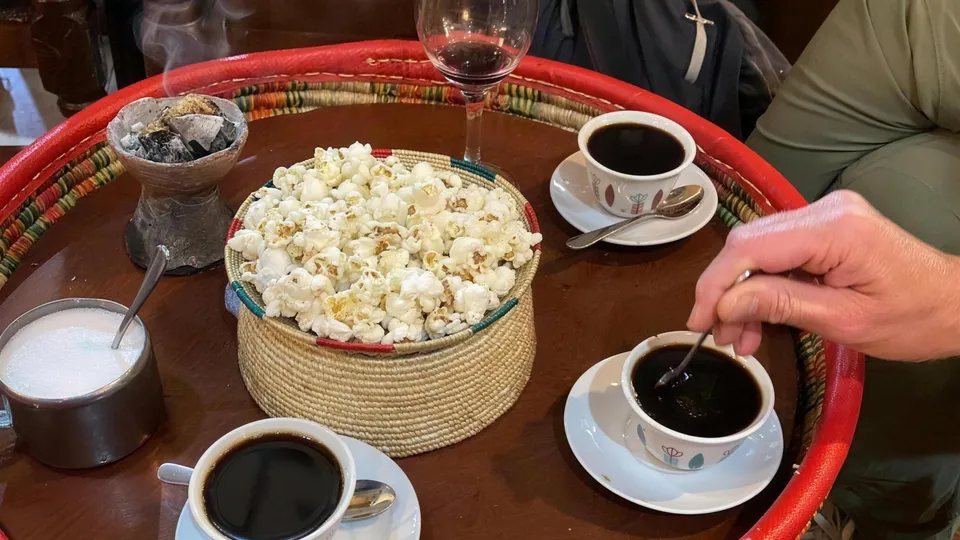
The buna ceremony is Ethiopia's social infrastructure — how news travels, disputes settle, guests are honoured. The sequence is unhurried and precise: fresh-cut grass strewn on the floor (bringing the outdoors in), frankincense on charcoal, green beans washed then roasted in a flat pan until they crack and shine. The roaster walks the smoking pan to each guest — waft it toward your face and compliment it. Then: pounding in a wooden mortar, brewing in the round-bellied clay jebena, and the theatrical pour — a thin arc from a foot above the tiny handleless cups, three rounds over the same grounds: abol (strong), tona (mellower), baraka (the blessing). Sugar is standard, salt or butter traditional in parts of the countryside; popcorn or roasted barley (kolo) circulates alongside.
Buna dabo naw — "coffee is our bread."
How to be a good guest
- Accept the first cup with your right hand; drink at conversation pace.
- Compliment the roast when the pan comes around — this is the moment for it.
- Stay for baraka if you possibly can; it's where the goodwill lands.
- In someone's home, a small gift (sugar, fruit) beats money; in a cultural house, tip the performer of the ceremony.
Where to experience it
Anywhere you're invited — an invitation always outranks a venue. Otherwise: cultural restaurants in Addis (Yod Abyssinia, Totot) perform full ceremonies nightly; Tomoca and the city's third-wave roasters serve the modern face; Harar's guesthouses do an eastern version with its wine-toned beans. For the source pilgrimage, head south: Yirgacheffe and Sidama washing stations in harvest season (October–January) will show you cherry-to-bean, and Kaffa's cloud forests around Bonga — a UNESCO biosphere — hide wild coffee you can walk beneath. It's the caffeinated equivalent of drinking Burgundy in the vineyard.