Three thousand years of Ethiopian identity begin in a dusty northern town where granite needles taller than ten-storey buildings rise from a field of royal tombs. Axum was the capital of an empire that traded with Rome and India, minted its own gold, adopted Christianity before Constantine's death — and, if you believe its priests, guards the Ark of the Covenant to this day. It is a small town wearing a colossal story.
Key facts
- Location
- Tigray Region, far northern Ethiopia
- Flight
- Addis → Axum daily, ~1.5 hr
- Headline sight
- Stelae field — 33 m carved obelisks
- The legend
- Chapel said to hold the Ark of the Covenant
- Time needed
- One relaxed day
- Era
- Kingdom of Aksum, ~100–940 AD
The stelae field
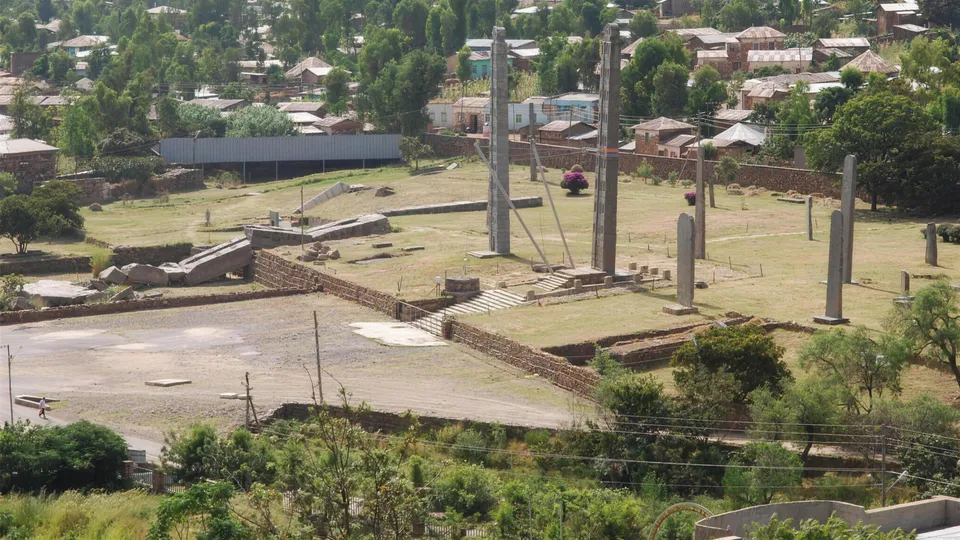
The heart of Axum is a field of over a hundred carved granite monoliths — grave markers of kings, raised between the 3rd and 4th centuries AD. Three dominate. The Great Stele, 33 m and ~520 tonnes, would have been the largest single stone humans ever erected — would have, because it fell as it was raised and lies in five colossal fragments, a monument to imperial overreach. The Obelisk of Axum (24 m) stands again after seven decades in Rome. King Ezana's Stele (21 m) never fell, leaning gently like a national metaphor. Each is carved as a tower-house with false doors and windows — skyscrapers for the afterlife. Beneath the field run the tombs themselves; several are open to enter.
St Mary of Zion and the Ark
Across the road stands Ethiopia's holiest compound. The old church (Fasilides-era, men only, by custom not malice) and the vast 1960s cathedral flank the small, fenced Chapel of the Tablet, where tradition says the Ark of the Covenant has rested since Menelik I — son of Solomon and the Queen of Sheba — carried it from Jerusalem. One guardian monk lives with it; no one else enters, ever. Whatever you believe, the sight of pilgrims pressed against the railings at dawn is unforgettable. The Kebra Nagast, Ethiopia's national epic, tells the whole story — read a summary before you come and the town rearranges itself into a legend made concrete.
The rest of the story
- Queen of Sheba's Bath — a vast ancient reservoir, still fetching water after two millennia.
- Dungur Palace ("Sheba's Palace") — the excavated footprint of a 6th-century elite mansion.
- Ezana's inscription — a trilingual stone (Ge'ez, Sabaean, Greek) recording the king's 4th-century conversion to Christianity; Axum's Rosetta Stone, casually kept in a shed by three amiable custodians.
- Tombs of Kaleb and Gebre Meskel — dressed-stone burial chambers on a hill outside town with views to Adwa's peaks — where Ethiopia defeated a European colonial army in 1896.
Practicalities
Fly from Addis (daily, ~90 min, often via Lalibela or Gondar — the northern circuit's flights interlink). A combined site ticket (~US$10–15) covers the stelae field and museums; licensed guides at the entrance (~US$20 for the circuit) are worth it here more than almost anywhere — unsigned, the stones stay silent. Sleep at Sabean International or Yared Zema; eat tibs and fresh juice on the main street. One relaxed day covers everything; pair with the Danakil via Mekele or continue the circuit to Lalibela. If Tigray's cliff churches call you, see the 10-day itinerary for how Gheralta slots in.