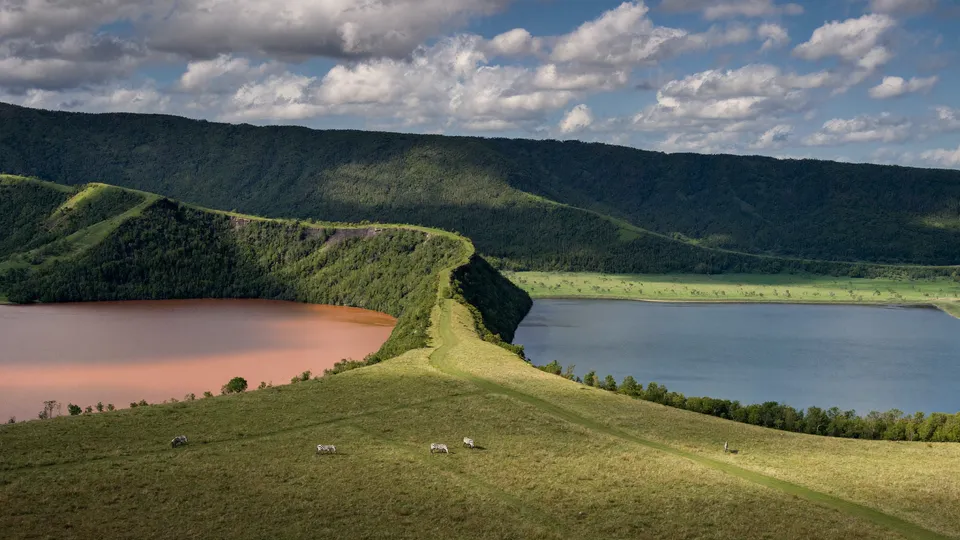
Stand on the ridge above Arba Minch and the Rift Valley performs its party trick: two enormous lakes, one rust-red, one blue, separated by a forested mountain saddle locals call the Bridge of God. Below, six-metre crocodiles pile up on a beach like driftwood with teeth; in the hills behind, one people has spent twenty generations carving an entire landscape into stone-walled staircases. Southern Ethiopia's natural wonders come stacked — here's the loop that collects them all.
Key facts
- Base town
- Arba Minch ('Forty Springs'), 500 km S of Addis
- Getting there
- Daily flights Addis → Arba Minch (~1 hr)
- Headliner
- Lake Chamo's 'crocodile market' — 5–6 m Nile crocs
- UNESCO site
- Konso Cultural Landscape (55+ generations of terraces)
- Wildlife
- Zebra & gazelle on Nechisar's white-grass plains
- Time needed
- 3–4 days for the full loop
Arba Minch: forty springs, two lakes, one view
The name means 'Forty Springs', for the water that bubbles up through the groundwater forest at the town's feet. Arba Minch is the perfect expedition base — daily flights from Addis, hilltop lodges (Paradise Lodge's terrace owns the view), fresh-caught tilapia and cold St George at sunset. Everything below is arranged in a day or half-day from here.
Lake Chamo: the crocodile market
Chamo holds some of Africa's largest remaining Nile crocodiles, and at the shoreline nicknamed the crocodile market they haul out in dozens — five and six-metre animals stacked like timber. The boat safari (morning for calm water) adds surfacing hippo pods, African fish eagles, pelicans and great white egrets; fishermen still cross these waters on high-prowed wooden boats, which takes a certain composure. Cost: roughly US$35–50 per shared boat, 2–3 hours, arranged in town or through your lodge.
Nechisar: the white-grass plains
East of the lakes, Nechisar National Park ('white grass') spreads its blonde savanna across the Bridge of God: Burchell's zebra in the hundreds, Grant's gazelle, and — if luck runs hot — the endemic Swayne's hartebeest. The groundwater forest at the park gate is a separate world of fig trees, baboons, bushbuck and those forty springs. A half-day 4x4 safari plus forest walk pairs neatly with the Chamo boat.
Dorze: the beehive village in the clouds
Forty minutes up hairpins into the Guge mountains (2,900 m — bring a layer), the Dorze people build twelve-metre beehive houses from bamboo and enset leaves — architecture with a lifespan of 60–80 years that simply gets shortened from the bottom as termites nibble, the whole house portable by group-lift. The visit done right includes the weaving cooperatives (Dorze cloth is Ethiopia's finest), kocho flatbread made from false-banana pulp with honey and fiery data, and a shot of home arak. Thursday's Chencha market is the local, low-key alternative to staged village stops.
Konso: the terraced kingdom (UNESCO)
Ninety kilometres south, the hills turn to staircases: the Konso Cultural Landscape, inscribed by UNESCO for its centuries of dry-stone terracing, walled hilltop towns entered through ceremonial gates, generation-marking olahita poles raised every 18 years, and carved waka memorial statues. Visit with a guide from the Konso Museum at Karat (the community's own interpretation centre): you'll walk a paleta town's maze, meet the current generation-pole, and understand why farmers here never met a slope they couldn't feed themselves from. The classic loop gives Konso a full half-day before continuing to the Omo Valley or returning to Arba Minch.