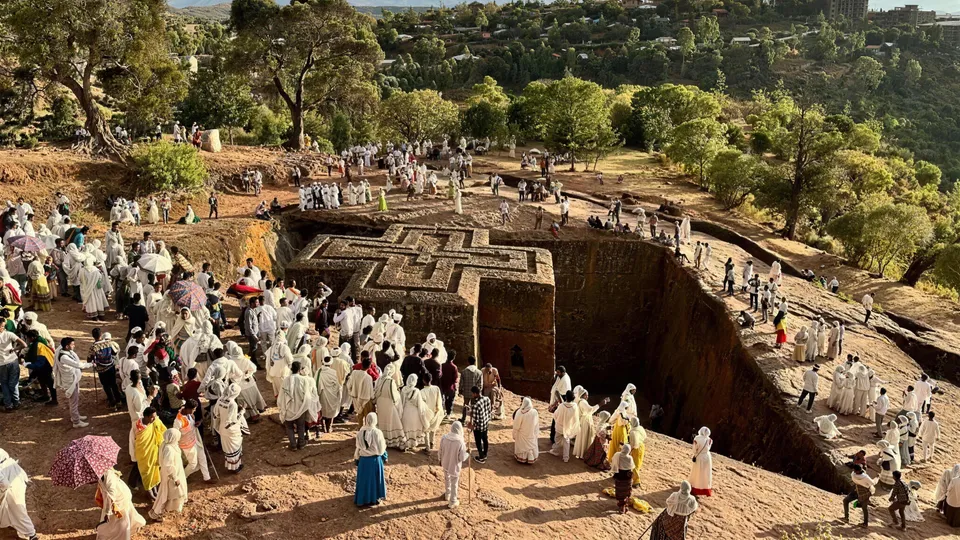
Axum was the seat of one of antiquity's great powers — a kingdom that minted gold coinage, controlled the Red Sea trade, and adopted Christianity in the fourth century, before most of Europe. What remains is a field of colossal carved obelisks, a chapel Ethiopians believe holds the Ark of the Covenant, and a town that has spent seventeen centuries living among its own ruins. It is also, right now, the hardest place on the northern circuit to reach responsibly. Start with the status box.
Key facts
- Advisory status
- Tigray region — 'Do Not Travel' (US/UK), July 2026
- Insurance
- Standard policies exclude advisory regions — verify
- Getting there
- Fly ADD→AXU (~1h 40m) when routes are operating
- Hotels
- Sabean, Yeha, Consolar — US$30–90
- Time needed
- 1 full day for the sites; 2 nights if flying
- Altitude
- 2,130 m — mild, dry, comfortable
Getting there
Fly. Ethiopian Airlines connects Addis Ababa (ADD) to Axum (AXU) in roughly an hour and forty minutes, sometimes via Gondar or Mekele. If you flew into Ethiopia on an ET international ticket, domestic legs are heavily discounted — book them on the same reservation rather than separately, which is the single easiest way to halve your internal transport cost.
Overland is not advisable under current advisories: the routes from Gondar or Mekele cross long rural stretches of Amhara and Tigray. Whatever you book, confirm the flight is operating before paying for hotels — northern schedules have been suspended and restored repeatedly, and a non-refundable room in a town you cannot reach is a common and avoidable loss.
What to see, in one well-paced day
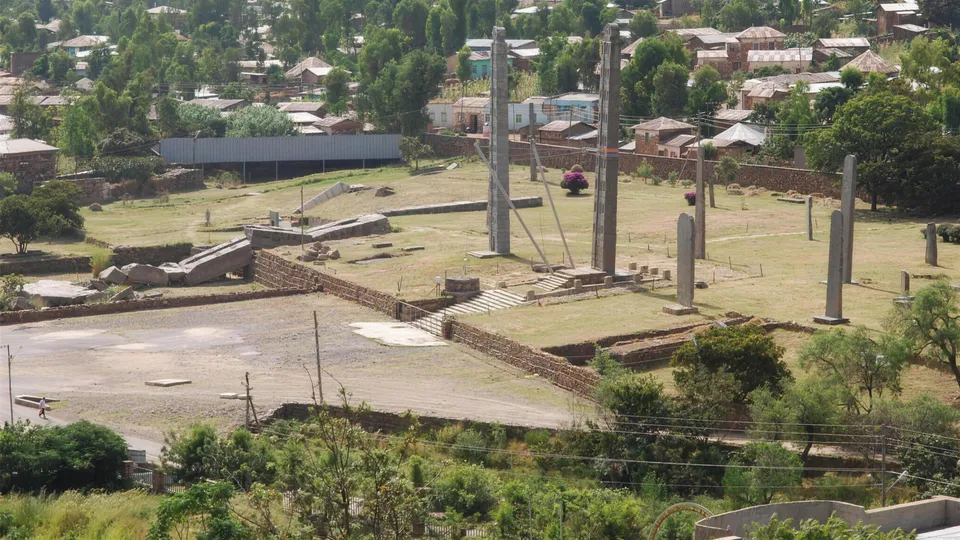
- The Northern Stelae Field — the reason you came. The 24-metre King Ezana stele still stands; the 33-metre Great Stele lies broken where it fell, probably during erection, and remains the largest single block of stone humans ever attempted to raise. The Obelisk of Axum, looted by Italy in 1937 and returned in 2005, stands re-erected nearby.
- The Chapel of the Tablet, beside St Mary of Zion — tradition holds it houses the Ark of the Covenant, guarded by a single monk who never leaves the compound and is seen by no one else. You cannot enter; nobody can. The old church admits men only, the newer cathedral everyone.
- Dungur ("Queen of Sheba's Palace") — a substantial elite residence with a preserved floor plan; the Sheba attribution is romantic rather than archaeological, and no less enjoyable for it.
- Rock-hewn royal tombs of Kaleb and Gebre Meskel — cool, precise masonry, and usually empty of other visitors.
- The Archaeological Museum — small, worth an hour, and the place the coins and inscriptions make the trade story concrete.
Deeper background is in our Axum obelisks and Ark guide; for guided options see tours and day trips.
Where to stay
Axum's hotel stock is modest and was hit hard by the collapse in tourism; check recent reviews rather than trusting listings, and confirm by phone that the property is open.
- Sabean International Hotel — generally the most comfortable in town; US$60–90.
- Yeha Hotel — the old landmark, dated but well positioned above the stelae field with the best views; US$45–75.
- Consolar International Hotel — solid mid-range, central; US$40–70.
- Budget guesthouses cluster near the centre at US$20–35. Confirm water and generator.
Practical notes
- Time needed: one full day covers the sites. Flight timings usually make it two nights.
- Buy the combined ticket at the stelae field office; it covers the main sites for several days.
- Hire a guide. The sites are sparsely labelled and the chronology is genuinely complicated — this is a place where a good guide changes the day entirely.
- Dress: shoulders and knees covered at St Mary of Zion; shoes off inside. See what to wear.
- Never photograph checkpoints, military or the Ark chapel guardian.
- Cash only, in practice. Bring birr from Addis; do not rely on ATMs or cards.
- Connectivity is unreliable and shutdowns have affected the region. Download maps and save confirmations offline — see our eSIM guide.
Axum is one of the most historically consequential places in Africa and, at present, one of the most complicated to visit. If conditions allow it when you travel, it rewards the effort enormously. If they do not, it will still be there — it has been, after all, for seventeen hundred years.