Ethiopian churches are not museums that happen to hold services; they are working places of worship that happen to be a thousand years old, and the people praying in them are not extras in your photograph. Dressing correctly costs you nothing, takes ninety seconds of thought, and changes how you are received entirely — from tolerated visitor to welcome guest. Here is exactly what to wear, what to carry, and the handful of rules that matter more than clothing.
Key facts
- Shoulders & knees
- Covered — men and women alike
- Shoes
- Removed before entering any church building
- Head covering
- Expected for women inside; bring a netela or scarf
- Trousers for women
- Fine in cities; a skirt is safer at rural monasteries
- Buy a netela
- 150–400 birr at any market or church gate
- Some monasteries
- Men only — Debre Damo, parts of Lake Tana
The rule, in one sentence
Shoulders and knees covered, shoes off, heads covered for women inside. That is ninety percent of it. The rest is nuance — and the nuance shifts as you move from a cathedral in Addis to a monastery reachable only by boat.
What to actually pack
- A netela. Buy one on your first day for 150–400 birr. This white cotton shawl, often with a woven tibeb border, is what Ethiopian women wear to church, and it solves shoulders and head covering in a single weightless layer. Men use a heavier version, the gabi. Wearing one is not costume — it is read as courtesy, and it is often met with visible warmth.
- Slip-on shoes. You will remove them constantly. Laces become a genuine irritation by the third church of the morning.
- Thick socks. The single most-thanked tip on this page. Lalibela's floors are cold, uneven, worn stone; some passages are dusty and some are damp.
- Trousers or a long skirt. Both fine for women in cities; a skirt below the knee is the safer read at rural monasteries. Men: long trousers, not shorts, at any church.
- A light layer regardless of heat. Highland sun is fierce but church interiors are cold, and sleeveless is not an option.
What not to wear
Nothing sheer, tight, sleeveless, or cut above the knee. No slogans or imagery that could read as irreverent. Hats come off for men indoors, and sunglasses come off entirely — talking to a priest through mirrored lenses is the fastest way to seem rude without meaning to. Leave the drone at home; beyond church grounds it is effectively banned nationwide without permits.
The rules that matter more than clothes
- The Holy of Holies is not for you. Every Ethiopian Orthodox church has an inner sanctuary — the maqdas — holding the tabot, a replica of the Ark. Only priests enter. This includes every Ethiopian in the building, so it is not a slight; do not lean in, and do not photograph through the doorway.
- Ask before photographing people. Priests will often agree, sometimes expecting a small tip (20–50 birr is normal and not extortion). Worshippers deserve the same question. Never use flash near paintings or manuscripts.
- Men and women stand separately in many churches — traditionally women to the left, men to the right. Watch, then follow.
- Do not turn your back on the sanctuary when leaving; locals step back a pace or two first. Small gesture, widely noticed.
- Fasting days affect everything. Wednesdays, Fridays and the long Lenten fast shape what is served nearby and how busy services are. Our calendar guide explains the rhythm.
Where the rules tighten
Lalibela is strict on shoes and cover but used to visitors; guides handle the choreography. Lake Tana's monasteries are more traditional — a skirt and netela smooth everything, and some islands admit men only. Debre Damo in Tigray is men-only and involves climbing a leather rope up a cliff face. Axum combines relaxed exteriors with an absolute prohibition around the Ark chapel. In Addis, cathedrals like Holy Trinity are the most relaxed of all — but shoulders, knees and shoes still apply.
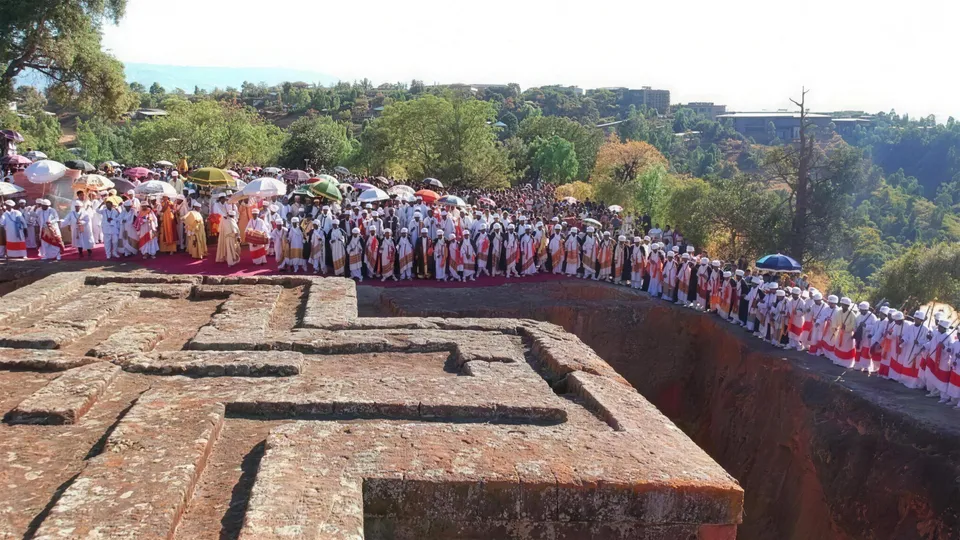
During Timkat and Meskel, expect enormous crowds and heightened solemnity: white is the colour everyone wears, and turning up in a netela means you blend into one of the great sights on earth rather than standing outside it.
A note on why this matters
Ethiopia's churches have been in continuous use since long before most European cathedrals were founded, and they have survived by being taken seriously. The priest who unlocks a door for you is not staff. Cover your shoulders, take off your shoes, keep your voice low, and you will find these are among the most generous religious spaces anywhere — places where a stranger who shows respect is quietly, genuinely welcomed.